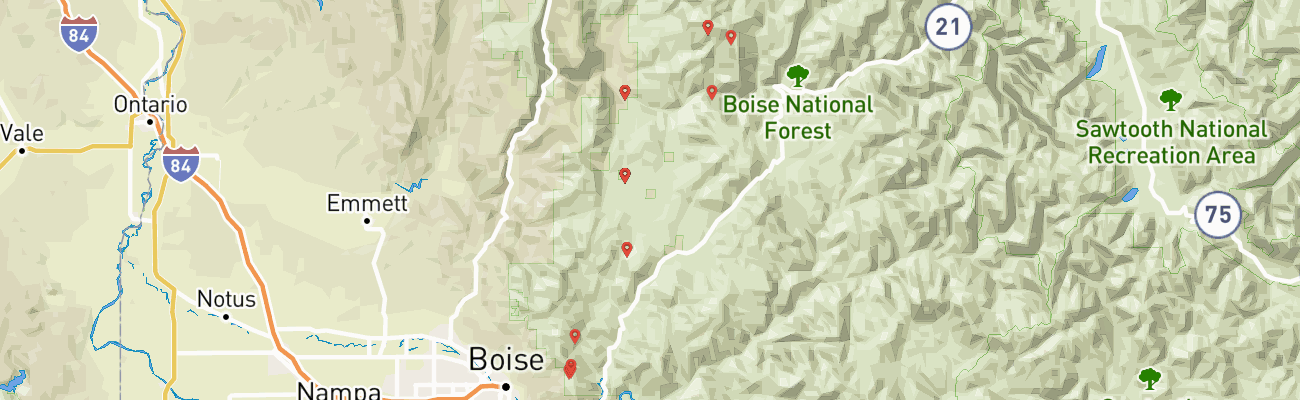
Scott Mountain

This year, the seventh, would be something different, my three brothers coming to ride the rugged and historic mountains near my home in Boise for the first time, our first Brother Ride outside the Nez Perce-Clearwater National Forest.
I have been excited to show off my local trails and terrain and expectations are high that I’ll be able to hit the elusive sweet spot between ride challenges and leisure time.


The four of us weave through neighborhood streets from my house to the foothills and up Rocky Canyon Road where dust forces growing separation until we re-group atop Aldape Summit. Except for Jesse. Where’s Jesse?
“I’ll go look for him,” I offer, expecting he’s stopped somewhere to re-secure his load.

I find him just down the hill, around a bend.
“It won’t start,” he explains.
We are glad our youngest brother Jesse has rejoined the Brother Ride after his one-year hiatus but it meant we needed another set of wheels. He’d sold his XT 250.
As luck would have it, Hunter was due for a motorcycle, having outgrown his, so I searched for something that might serve both purposes. After inquiring about several, always a day too late, I saw Ryan Janda’s 2007 Husqvarna TE 450.
Ryan said he’d replaced the battery, changed oil and ridden it recently but a prospective buyer had flooded it. “You can smell the gas,” Ryan said as we ran the starter in vain. It seemed uniquely capable — light-weight and powerful — of meeting my dual needs so I agreed to buy it as-is for $600 off his asking price.

It wasn’t just flooded. It had no spark. A few days of trial and error and shop manual diagnoses indicated a bad stator. Sure enough, I found it broken from its mounts within the flywheel. The bike would have died immediately, not something you’d fail to notice.
With that replaced, she started right up and began dumping gas out the bottom of the carburetor. That explained the gas smell Ryan blamed on flooding and perhaps why he had it parked in the grass just next to his driveway — couldn’t see spillage there.
Husky forums led me to the float valve o-ring which, once replaced, stopped the leak. Hooray. It also implied the bike hadn’t run for a long time. That’s what dries out the o-ring.
I was glad to solve the issues with only minor expense but last minute work, no chance to trail-test, left me nervous, left me to think the worst when I hear Jesse say it’s not starting.

Jesse had stopped to re-secure luggage, as expected. The allegedly new battery I wore down during my repairs should have charged by now but still won’t turn the starter. Flooded procedure kick starting brings it to life. “We’ll see what’s up with that later,” I assure Jesse.
Gathered again, we turn from Aldape to continue along the Boise Ridge, out of the desert and into the treeline above Boise.

Not knowing if the Husky was going to make the ride until the last minute, I didn’t outfit it with a larger tank or luggage rack. In lieu of that, I intended to load it up with my extra fuel pack but Jesse couldn’t find a way to attach it — which could prove interesting later. Just keeping his luggage secured is requiring finesse.
Minor luggage shenanigans have been part of most every brother ride so this feels right, actually.

A quick pace with brothers on my heels through sun and shade, whoops and swales, smell of pine and sage, is a particular joy. We finish descending the Eagleson Trail to Robie Creek then speed up on the dirt and gravel roads along Clear and Grimes Creeks.
I have often thought Grimes Creek was aptly named — a little grimey — but a wide area within a shaded bend, inaccessible to cars, catches my eye. (The creek is actually named for George Grimes who, along with “Moses Splawn and a small party of prospectors, discovered valuable placers on Grimes Creek, August 2, 1862.”¹)

“Come check this out!” I yell when my brothers pull in a few minutes later. After looking a moment at furtive orange shapes in the water I’d realized they were spawning salmon.
“Kokanee,” Joel notes when they reach the water’s edge. That’s something we’ve not seen on a ride before.

Sockeye migrate to the ocean and back, while kokanee spend most of their lives in lakes and then venture upstream to spawn, while changing from their normal silvery appearance to crimson with a green head, a hooked jaw and humped back.¹

“It’s a couple more hours to our target campsite,” I explain. “We could call it a day and stay here.”
We were late getting out of Boise. I waited for the mail to take care of some banking then, as I crouched to the concrete garage floor while packing, my phone that had survived much worse tumbled from my pocket to its death. And cell phone stores are never fast.
After briefly mulling the idea of staying here, we vote to forge on.

“It’s good you have that locator beacon,” the spectacled, grey haired man behind the counter at Donna’s Place says, nodding to the yellow box on my shoulder.
“Family requirement,” I answer with a chuckle, though that’s not entirely true. Given cost versus possible consequence, it just makes sense.

We have arrived in Placerville, an 1862 mining town on the National Register of Historic Places. We sit on the store porch a few minutes, drinking sodas and watching nothing happen.

George, who I know as the Placerville Museum docent,¹ stops there on the road in front of Donna’s Place on his ATV to chat. Jeremy asks him about places to filter water and George suggests what sounds like a ditch just around the bend outside of town. “Been drinking out of that for fifty years,” he says.
When he finally says “I gotta run” it makes me curious to know what in this little town adds up to a “gotta.”
After George leaves, a truck pulling a large camper trailer stops in the same place, the middle of the road, blocking a pickup behind him. I give the latter driver a shrug from my place on the porch. When the lead driver finally moves, the truck behind comes alongside and the two appear to have words before the trailing truck peels out and speeds away. I guess mountains aren’t immune to road rage.


Joel had a hard digestive night and is glad for the modern “Necessary House” in Placerville. We don’t hassle him more than is appropriate.

Refreshed, we continue north on forest roads from Placerville along miry waters impounded by rows of regurgitated rock, lasting reminders of intensive mining.
I notice something out of place as I descend into Garden Valley and realize it’s the bridge. Construction was underway when Michael and I were last here¹ and now the old one-lane truss bridge over the South Fork of the Payette has been replaced by unadorned iron and concrete. I stop there above the water to await my brothers’ descent from the hills.


After a quick gas-up in Garden Valley, we flow single file along the winding Banks-Lowman highway by sunlit escarpments east to Scott Mountain Road.

The sun is low as we ascend the rough road to the high ridge, it’s oblique rays shifted red by smoke drifting in from Klamath National Forest fires in Northern California and Oregon.¹ The temperature drop is palpable. I think we’d better find a place to camp soon.


We ride along the panoramic ridge toward Scott Mountain Lookout until stopped by a locked gate. “Wait here while I look around a minute,” I tell Jesse. I would love to find a place to set our tents with this great view but I find everything around rugged and uneven.
So we begin backtracking, heads swiveling, searching for a bit of level ground. About a mile on we spy a two-track spur pointing at a promising knoll.

“This place is awesome,” we all agree. After a bumpy if short ride from the ridge, we circle our rides near a house-sized outcropping with three-hundred-and-sixty degree views of other mountain tops. Burned out trees clutch at the sky above scattered shrubs and lupine, red and purple moored in sandy ground.


I thought at first it was new cover for an old mistake. Jeremy borrowed a tent for last year’s ride and only discovered while setting up the first night he had in fact only borrowed a tarp.¹ That was funny.
This time, apparently, it’s serious. Jeremy is preparing for some long hikes with minimal gear including a square tarp with multiple eyelets allowing various shelter configurations (“pitches”). When he admits his pitch knowledge is yet theoretical, from watching YouTube videos, I’m reassured to know this could yet be funny.

With night quickly falling, we hasten to set up our tents and tarp then build the fire we’ll face the rest of the night. While I’m discovering my Jetboil burner is defunct (good thing Joel and Jeremy have theirs), the others have discovered we have data service up here.

We have upgraded this year to Bluetooth speakers, the Braven unit Jeremy brought with an eclectic music selection (one more thing to charge off our overtaxed motorcycle batteries¹). A head or an arm bobs — “only one body part at a time,” Abbott style, as Joel notes — as freeze dried dinners stew and we strain to see the stars.

As midnight approaches, we spot points of light along the ridge growing steadily nearer. A car at this hour? Headlights slowly sweep the haze like alien spotlights, almost tangible. The beams arc this way and that as if the car is making tight turns then pausing. It doesn’t make sense even as it continues to come closer.
by Jason Abbott