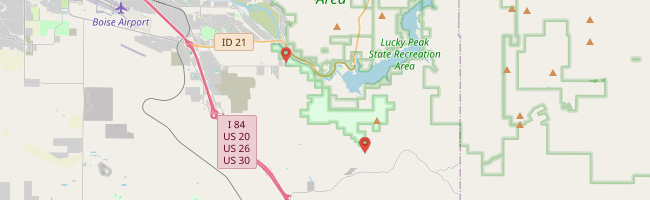
Hunter’s small frame has meant off-road rides have been less enjoyable than he expected. On rough ground, he’s a pebble in a paint mixer. But he’s put on some weight the last year and I think we should try again. The Oregon Trail passed just a few blocks from our home. Today Hunter and I are going to follow that ancestral line east back along the Boise River and out of town. “Hang on tight,” I warn as we turn off pavement to face a rocky climb. It will be wagon trail the rest of the way. “Shall we stop there and have a rest?” I ask in jest, turning my head in the direction of an abandoned pull-out bed along the trail, less than a mile on. “No,” he protests. He’s been wary of whimsy in recent years. It may be the natural course of his personality but I worry that pressure to conform—counseling, medication, check-lists—is robbing him of something.

Hunter’s small frame has meant off-road rides have been less enjoyable than he expected. On rough ground, he’s a pebble in a paint mixer. But he’s put on some weight the last year and I think we should try again.
The Oregon Trail passed just a few blocks from our home. Today Hunter and I are going to follow that ancestral line east back along the Boise River and out of town.
“Hang on tight,” I warn as we turn off pavement to face a rocky climb. It will be wagon trail the rest of the way.
“Shall we stop there and have a rest?” I ask in jest, turning my head in the direction of an abandoned pull-out bed along the trail, less than a mile on.
“No,” he protests. He’s been wary of whimsy in recent years. It may be the natural course of his personality but I worry that pressure to conform—counseling, medication, check-lists—is robbing him of something.


Subdivisions become sagebrush as we travel 150 years into the past, to when the Oregon Trail was active, in just a few miles. We stop atop basalt cliffs that line this stretch of river. Below is the hundred-year-old dam that diverts water to irrigate the desert of the Snake River Plain.

“Isn’t this where I rode my bike?” Hunter asks. He remembers joining me one cold evening for some photographs from this location.
“Yep.”
I resist cautioning him about the cliff edge. He gets plenty of admonition elsewhere.


We dip and weave as we pick up speed back on the trail. I remember when I was Hunter’s age and the neighbor dad, Mr. Bauer, offered me a ride on his metal-flake maroon snowmobile called the Scorpion. We were suddenly blasting down a snow-packed country road. I could barely hang on. I was just about to yell, “I’m falling!” when he slowed to turn around.
“You doing okay?” I call back to Hunter.
“Yeah!” he answers.
Good—scary enough to be fun but not more. He’s riding a lot better this time. And I think he’ll enjoy the historic site ahead. He’s a fact aficionado, often regaling us with details of the solar system, history or something in the ocean. I wouldn’t be surprised if he knows of Captain Bonneville.
The formal structure of Bonneville Point¹ is unexpected from this direction, seeming to rise up from nowhere. The large parking lot, accessible from a gravel road on the opposite side, is empty. It’s just us here.

The point is named for U.S. Army Captain Benjamin Bonneville, an early Idaho explorer whose party reached this viewpoint along an old Indian trail in 1833. Later, it became a fondly remembered location for emigrants on the Oregon Trail as they took in their first view of the Boise River Valley.¹
As the story goes, Bonneville’s French troops were so happy to see a valley of trees after many miles without that they cheered, “les bois, les bois,” meaning, the woods, the woods! And so the river and town would be named.

More fascinating to a nine-year-old boy than this local history are the fantastic thorns, several inches long, of the locust trees. “Think you can climb it?” I quip as we walk near one.
“No,” he laughs with mock complaint, “but I bet I can climb that,” he says, pointing at the old monument.
“Sure.”


Whatever important things Captain Bonneville did will have to wait for the adventures of Hunter. From the monumental rock climb he begins a safari of the fenced area, pursuing the great grasshopper. Soon he has his quarry on proud display.
“Look, I got one!”

Being distracted by the little things can be a joyful deficit to have. The outdoors don’t appeal to him like candy or video games but once out here he never fails to find his imagination, adventure in the simplest things. I love to see it.

Sometimes I try to project myself into Hunter’s future. Will his memories be good ones? With all these tactics to conform are we gambling away a piece of his childhood for uncertain prospects? Will there come a point in time when he can look back and say the frustrations were worth it?
For many travellers on the Oregon Trail, that point was here, Bonneville Point. They crested this hill to the site of a river, green valley and promising land beyond. They had traded the lives they had for the uncertain prospect of the West, and faced many hardships to get here.


I remember trails from which I was turned back by hardship—snow, rocks, water, whatever. I couldn’t get where I was going. I recall few times, however, wishing I’d not even tried. In fact, I’m glad to have tried and the trying becomes the story I value most.
If that tells me something about future perspectives then I guess I should dwell less on questions of the future and find satisfaction in what we’re doing now, the journey still underway. Tonight that means home to bed. Tomorrow we conform.
by Jason Abbott