In the Hills
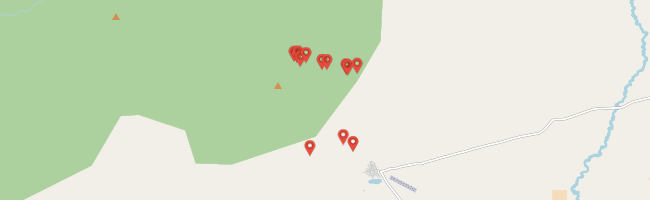
The hills around Tuscarora are a patchwork of tailings, pilings and pits between crisscrossed dirt roads. After Laura and I explored as much as we could on foot, and were still waiting for the rest of the Boise group to arrive, we decided to unburden the motorcycle of its luggage and see where the roads might lead.

The hills around Tuscarora are a patchwork of tailings, pilings and pits between crisscrossed dirt roads. After Laura and I explored as much as we could on foot, and were still waiting for the rest of the Boise group to arrive, we decided to unburden the motorcycle of its luggage and see where the roads might lead.

We headed for the first obvious target, the orange obelisk, a remnant of the gold smelter above town.

We encountered large open pits at regular intervals — maybe mine shaft ventilation or remnants of hand-dug pit mines — each one encircled by a wire fence, like a crown of thorns, and festooned with brightly colored warnings of death and damnation should you trespass. It is hard to resist those invitations to sin. I had to let Laura hop off to investigate.
“Is it very deep?”
“No.”
And on we’d go.

The first few roads we followed simply faded out atop one hill or another. The view was nice but Mount Blitzen taunted us: “c’mon, you can get farther than that.” We had to keep trying.

With time to kill, any artifact was cause to stop. And there were plenty. We slowly made our halting way up the mountain on whichever road seemed to go the right direction. Just as I was feeling optimistic about our progress, having made it some way up, the road abruptly ended. Again. Curses.

But wait … the placement of a big, lonely shrub in the crux of a trench at the edge of the road seemed odd.
“Laura, go see if there’s anything behind that shrub.”
Sure enough. It hid the entrance to a mine, doubtless full of wonders for all its secrecy. Fighting past the shrub and swarm of flies gave us our reward: a rotting mattress, rusting cans and rubble piled to the ceiling. Blitzen wasn’t giving up easily.
As we stood looking back toward town, contemplating our next move, Laura got the call. Her classmates had arrived.

Back in town, Laura disappeared to lead her friends on tours of the things we’d discovered in our hours there. As I was hovering around the hotel, the cook (who doubled as the nurse) told me he’d discovered an “oasis” while out on his four-wheeler the previous year.
“Oasis” sounds exciting, a place of respite for exotic women and refuge for dangerous men. His vague directions about heading “that way” (north) were more than enough to send me on my way.

I took what seemed to be the main jeep trail north until, coming into a draw with a trickle of water and greener than most, I followed a hunch to turn up the fading path towards its source. Although a pretty spot, I hoped to get more for my efforts. Looking about, I noticed a hint of trail to my left that, if I was lucky, could take me straight up out of the draw. Why not?

The trail became steeper and more ambiguous as it climbed. I leaned over the handlebars and twisted in more throttle. Up and up, bouncing over rocks, pulling free of the clutching fingers of brush that pressed in on the fading trail. The farther I climbed, the more committed I became, determined to see it to the end, whatever end may come.

A blue carpet was laid out anticipating the abrupt end to the brush as the trail rounded off into a wide open natural rock garden with a spectacular view out across the whole valley. I was momentarily stunned at the sudden transition to beauty.

I set the motorcycle on its kickstand, glad it brought me here, and walked around slowly, relishing details in flowers, lichens and rocks.

There were little flowers of every shape and color, hardly discernible from a distance. Even standing still brought a new epiphany at every glance about.


If the flowers seemed a rare confetti of color, the lichens were an unexpected explosion of hues across already colorful rocks.

The surprising beauty only added to my curiosity about what lay further up the mountain. The trail was only occasionally visible, apparently unused for some time, but with no trees or shrubs, I had enough clues to head the right direction.

I almost turned back when rocks, a switchback and a steep incline conspired to stop me. But after scouting ahead on foot, and at first deciding it wasn’t worth the risk, I realized I would later regret not making the effort. And so I found myself hurled upward by the growling boxer engine over terrain I half-expected to bring me down.

But it didn’t. And I was able pull into an almost-level area behind some rocks, take a long drink and feel glad. I would hike the remaining distance to the summit.

I found myself walking up an old road made nearly invisible by vegetation. It obviously hadn’t been used in a long time. Deer kept a close eye on me as I crossed into their territory.

Perhaps I could have ridden further but I enjoyed being on (safe) foot while not caring about how long it might take. I trudged upward until the motorcycle nearly disappeared in the blue distance.

While crossing some rocks, I spotted what looked like a styrofoam cup and was mad to see garbage all the way up here. As I drew closer, though, I saw it was part of a set of bones — perhaps an ancestor of those presently supervising me — shattered at the base of a rock overhang.

The road ended short of the summit. I climbed the remaining distance up onto rocks higher than everything else around. Blitzen had turned me back several times that day but finally it was mine.


Looking round and round, I saw only mountains; no sign of civilization aside from Tuscarora. It seemed I had a lot of riding left to do. (I learned later how deceiving the distances are. I think the treeless mountains registered in my mind as hills.)


I saw with my own eyes where I needed to go next — after food and sleep. I had missed the scheduled lunch by a few hours and ran out of water before finishing my hike. I backtracked to Tuscarora where nobody seemed to notice I’d been gone. And that was probably best. I sat down in my camp-chair, sandwich in one hand, pen in the other, and began to record what I’d seen. Tomorrow would be another story.
by Jason Abbott